As for the DeArmond, it worked great when I got it, except for an intermitent short in the cable by the jack. So I fixed that. But then a problem developed where the pickup only put out a quarter of its output. This happended on-and-off, but eventually stayed muted all the time. So, I have to crank my Peavey Classic 30 all the way up just to get useable signal. But, damned if it doesn't sound pretty good. It really does have that old-school single coil sound!
Also, I made some changes to my Eastman 805. I had taken the guard and pickup off, and I got a really nice repro tortise shell guard from archtop.com. It's shaped like an early 30's, 16" L-7 guard, but triple bound and redish shell color. I had my tech install the guard and also do some wiring to acommodate the new DeArmond. I had him wire the pickup into the end pin jack, but put an RCA connector in-between so I can take the pickup completely of the guitar whenever i want. He's also modifying my 810 for the same thing, so I can put the pick up on either guitar. Also, I had him redo all of the pick up cabling with mogami wire, because the old wiring was pretty frayed.
Here a before and after on the 805:
Before:
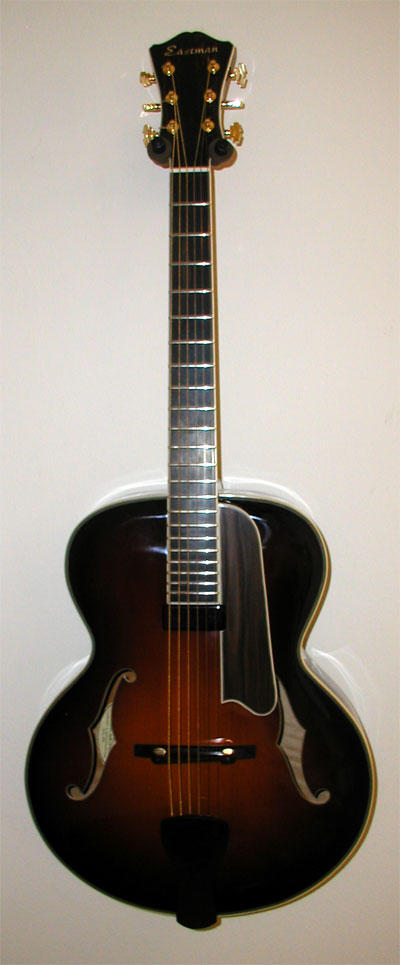
After:

curious. you just paid a lot for DiArmond mics, and after 30 years of fighting with mine, I just sold mine (to a guitar shop). Yeah, they have a sound, but I just found them too clunky, too heavy, and I was tired of hum and interference problems (beyond just being single coil, probably due to the ancient wiring inside). So I switched to a single-coil bar that fits on the base of the neck just before the fretboard, and, well, it's a different sound (after 30 years, I can't expect to adapt too fast ;) but it is not an unpleasant sound.
ReplyDeletebut man, it's a reliable sound, there every time, every gig, and doesn't get bumped out of place by an arm.
but, if you like them, then that's good too, 'cause it means they are likely not to spend long in that shop's parts drawer before somebody takes them home to make music.
and that's what it's all about.
This comment has been removed by the author.
ReplyDeleteGood quality info. Lucky to me I came to your website not on purpose, but now I have bookmarked it. Moon Jams
ReplyDeleteSilicone molds are indispensable tools for creative projects and practical applications, offering unmatched versatility and reliability. Made from high-quality, food-grade silicone, these molds are non-toxic, heat-resistant, and flexible, making them ideal for baking, crafting, and more.
ReplyDeleteIn baking, silicone molds are perfect for creating detailed cakes, chocolates, candies, and muffins. Their non-stick surface ensures effortless release, preserving intricate designs without the need for excessive greasing. These molds are oven-safe, freezer-friendly, and dishwasher-safe, providing convenience and durability.
For crafters, silicone molds open the door to endless possibilities. Whether you're working with resin, soap, wax, or clay, these molds allow for precision and creativity in every project. Available in a variety of shapes and patterns, they cater to diverse artistic needs, making them a favorite among DIY enthusiasts.
One of the standout features of silicone molds is their reusability, which promotes sustainability by reducing waste. They are lightweight, easy to store, and maintain their shape even after repeated use. Their ability to withstand extreme temperatures ensures reliability for both hot and cold applications.
Whether you\u2019re a baker, artist, or hobbyist, silicone molds are essential tools that combine functionality with creativity. Their durability, flexibility, and eco-friendliness make them a must-have for anyone looking to craft with precision and ease.